Please Enter Keywords




Please Enter Keywords



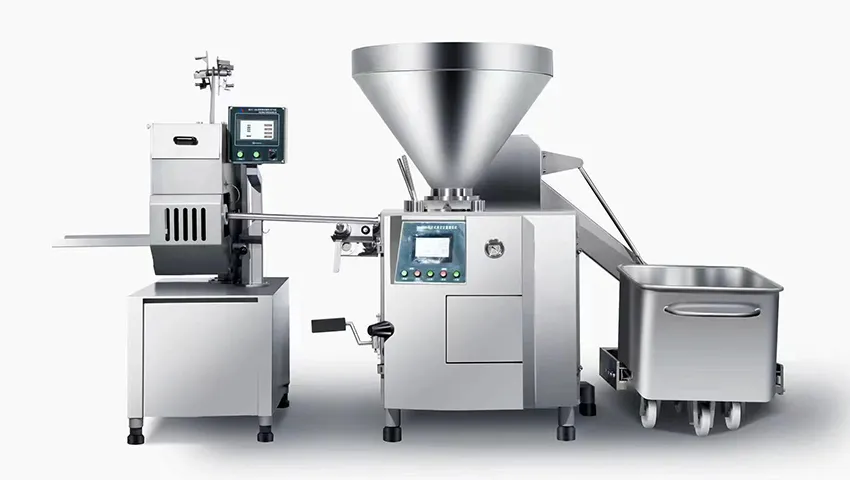
I. Pre-use Preparation
1. Equipment Inspection
• Ensure stable connection of power supply and air source (if applicable), and the equipment casing is well grounded.
• Check whether all components (such as hopper, filling tube, piston/screw, transmission system, etc.) are firmly installed without looseness or wear.
• Clean the hopper, filling tube, and components in contact with the filling to ensure no residual grease or debris (can be rinsed with hot water or disinfected with special cleaning agents).
2. Raw Material Preparation
• Pour the minced meat (which should maintain uniform humidity and avoid caking) into the hopper, noting that the height of the filling should not exceed 2/3 of the hopper's volume to prevent overflow.
• Check the filling for impurities such as bones and fascia to avoid blocking the filling tube.
II. Operation Process Guide
1. Power-on and Trial Run
• Connect the power supply, start the equipment, and observe whether it runs smoothly without abnormal noise or vibration.
• Run the machine empty for 1-2 minutes to check if the filling tube discharges smoothly.
2. Filling Operation
• Slowly adjust the filling speed knob (usually located on the control panel), and it is recommended to set the initial speed to medium-low speed (such as 50% power) to avoid casing rupture.
• During filling, continuously replenish the filling in the hopper to maintain a stable filling height and prevent air from entering, which may affect the accuracy of the filling volume.
3. Shutdown and Cleaning
• Before shutdown, empty the filling in the hopper first, and rinse the hopper, filling tube, and piston/screw with water or cleaning solution to ensure no residue.
• Disassemble removable components (such as filling tubes and seals), and thoroughly clean them with a soft brush to avoid scratching the surface of the components with hard objects.
• Wipe the equipment surface with a damp cloth, and never directly rinse electrical components with water.
III. Filling Volume Adjustment Method
1. Principle of Quantitative Adjustment
Sausage quantitative filling machines typically control the filling volume through volumetric measurement (such as piston stroke, screw speed, or stepper motor pulse count). Common adjustment methods include:
• Mechanical adjustment: Adjust the piston stroke length or the discharge volume per screw rotation through knobs or handwheels.
• Electronic adjustment: Input the preset weight or volume on the control panel, and the equipment automatically controls the filling volume through sensors and programs.
IV. Common Problems and Solutions
Problem | Possible Causes | Solutions |
Uneven filling volume | Uneven filling, piston air leakage | Re-mince the filling and replace the seal ring |
Casing rupture | Excessive filling speed, thin casing | Reduce the speed and replace with high-quality casing |
Difficult discharge | Filling caking, blocked filling tube | Stir the filling and disassemble for cleaning the filling tube |
Abnormal equipment noise | Loose components, lack of oil in the transmission system | Tighten screws and add lubricating oil |